

European Ecodesign regulations define minimum thermal efficiency requirements for heat recovery systems in non-residential ventilation units. For most energy recovery systems, a minimum temperature efficiency of 73% is sufficient to comply with the current Ecodesign requirements.
While this approach ensures a minimum level of sensible heat recovery, it does not reflect the full energy-saving potential of enthalpy heat exchangers. In climates
Unlike the mandatory requirements for thermal efficiency established by the EU Ecodesign Regulation, the Eurovent Summer Energy Efficiency methodology is an industry based assessment framework developed by Eurovent. It considers both sensible and latent heat recovery when assessing the seasonal energy performance of an AHU. This allows the additional energy-saving potential of enthalpy heat exchangers to be reflected in the overall energy performance assessment, particularly in climates with high latent cooling loads.
Cooling in Warm Humid Climates: The Hidden Energy Problem
Cooling outdoor air involves two separate processes: reducing the air temperature and removing moisture from the air. The first process is called sensible cooling, while the second is called latent cooling or dehumidification. In dry climates, cooling systems mainly deal with sensible heat because the air contains relatively less moisture. However, in humid regions, for example along the Mediterranean coastline, moisture removal becomes a major energy consumer because the cooling coil must condense large amounts of water vapor from the incoming outdoor air. This additional latent load increases cooling energy demand, chiller capacity requirements, operating cost, and total HVAC energy consumption. For example, two locations may both have an outdoor temperature of 35°C, but their cooling requirements can be very different. A hot dry climate with a dew point of around 10°C mainly requires sensible cooling, while a moisture rich outdoor air conditions with a dew point of around 20°C creates a much higher latent cooling load because significantly more moisture must be removed from the air. Eurovent’s summer efficiency approach accounts for this difference and considers dry-bulb temperature and humidity conditions when evaluating AHU performance.
Eurovent’s Summer Energy-Efficiency Methodology
Eurovent evaluates summer AHU performance from a system-efficiency perspective, not only by the temperature efficiency of the heat recovery component. In warm and humid climates, cooling demand depends on both dry-bulb temperature and dew-point temperature: dry-bulb temperature drives sensible cooling load, while dew point reflects moisture content and therefore latent cooling load. This is why Eurovent’s summer methodology considers outdoor temperature, humidity recovery, heat recovery performance, pressure drop, and fan energy together.
The key issue is that a sensible heat exchanger can reduce supply-air temperature but does not significantly reduce the moisture load entering the cooling coil. In humid climates, this means the AHU still requires considerable energy for dehumidification. By including humidity recovery in the summer energy-efficiency calculation, Eurovent recognizes that using an enthalpy heat exchanger instead of a sensible heat exchanger reduces the cooling and dehumidification demand. At the same time, pressure drop is considered because thermal savings can be partly offset by higher fan energy. This makes enthalpy exchangers relevant for the problem, as they help reduce both sensible and latent cooling loads under warm humid conditions.
Case Study: Energy Savings in a Mediterranean Climate
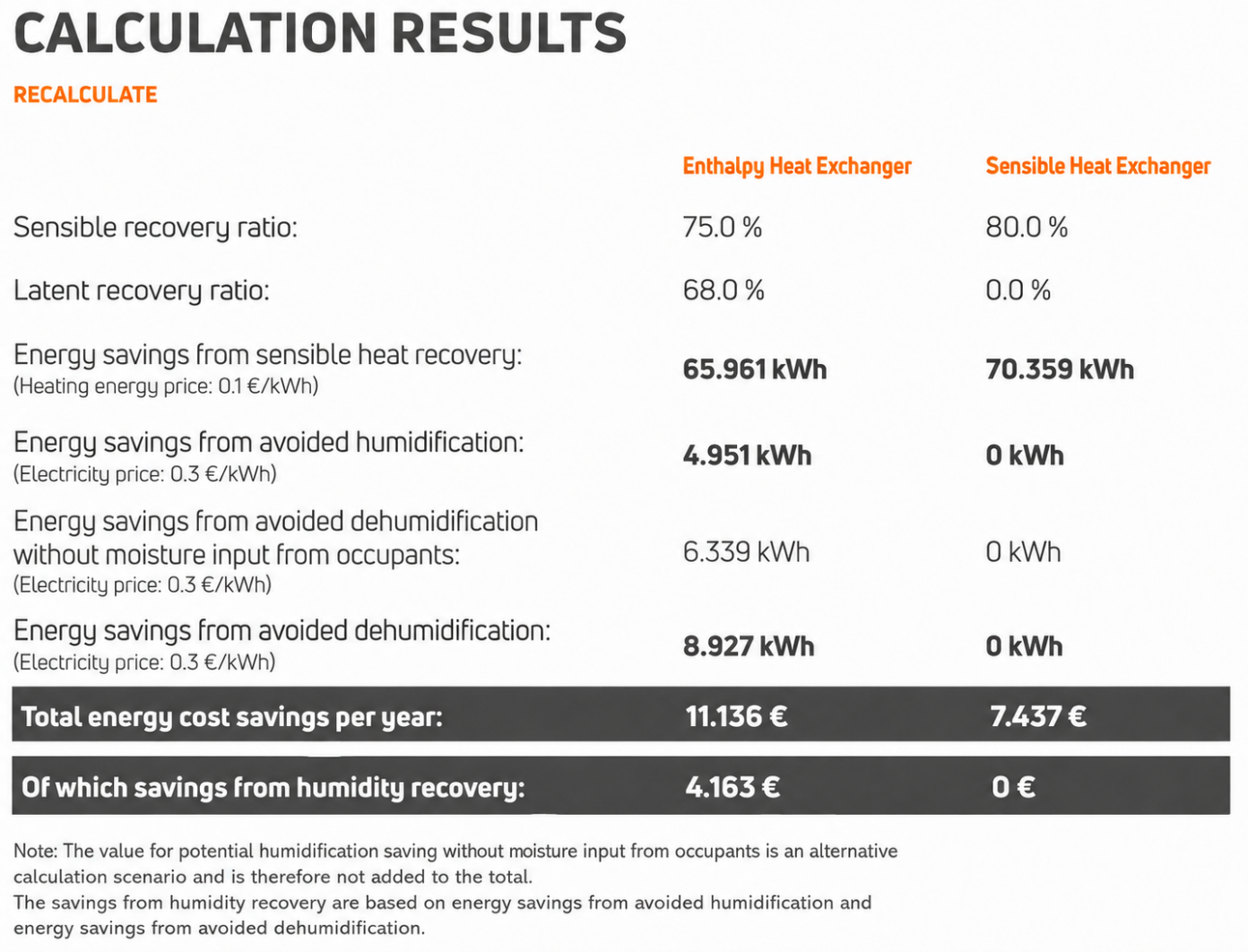
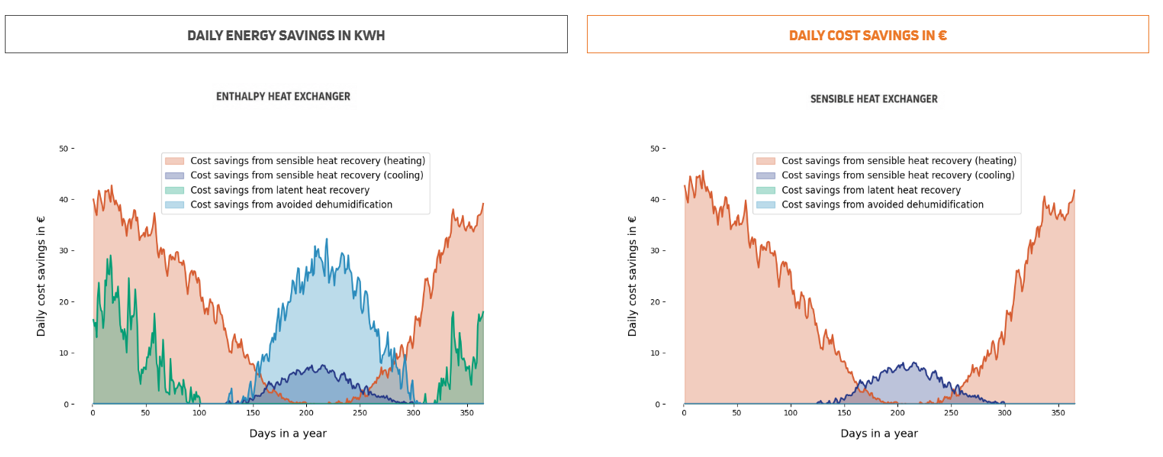
To illustrate the economic impact, we compared the performance of an enthalpy heat exchanger with that of a conventional sensible plate heat exchanger using a representative case study for Barcelona. Unlike hot, dry inland climates, Barcelona experiences warm summer conditions combined with relatively high outdoor humidity, resulting in a significant latent cooling load. Consequently, the cooling system must not only reduce the air temperature but also remove a considerable amount of moisture from the incoming outdoor air. The cost savings here are calculated for an air handling unit with an airflow rate of 5,000 m³/h, based on an average occupancy of 150 people per day and a duration of stay of 10 hours per day. Local climate data for Barcelona was used to calculate the annual energy demand and the corresponding operating cost savings.
Results
Enthalpy Heat Exchanger:
- Total energy cost savings per year: 11’136 Euro
- Of which savings from humidity recovery: 4’163 Euro
Sensible Heat Exchanger:
- Total energy cost savings per year: 7’437 Euro
- Of which savings from humidity recovery: 0 Euro.
Even though the sensible heat recovery is slightly higher with the sensible only heat exchanger, the enthalpy heat exchanger shows significantly higher total annual savings due to its ability to recover moisture. In Barcelona’s climate, where humidity plays a significant role in cooling and air treatment, this moisture recovery results in a major additional cost-saving benefit.
Summary
The Eurovent Summer Energy Efficiency methodology provides a comprehensive assessment of AHU performance by considering both sensible and latent heat recovery, together with other factors that determine the overall energy efficiency of the unit. In warm and humid climates, such as Barcelona, the energy required for cooling and dehumidification accounts for a significant share of the annual HVAC energy demand. Under these conditions, efficient humidity recovery becomes a key contributor to improved seasonal energy performance.
With its high latent recovery efficiency and outstanding overall energy recovery performance, The VAPOBLOC product line of Polybloc offers an effective solution for residential ventilation and air handling units with airflow rates ranging from 50 to 20,000 m³/h. By enabling efficient heat and moisture recovery, VAPOBLOC addresses the performance criteria considered in the Eurovent Summer Energy Efficiency methodology. It supports improved seasonal AHU performance in climates with significant latent cooling loads, helping to reduce operating costs while maintaining indoor comfort.
At the same time, VAPOBLOC helps manufacturers and building owners meet the growing demand for sustainable building operation by reducing HVAC energy consumption, improving year-round energy performance, and maintaining high standards of hygiene without compromising cost competitiveness.
About Polybloc
For more than 40 years, Polybloc has been developing and manufacturing high-performance heat recovery systems for applications with the highest demands on energy efficiency, hygiene, and operational reliability.
With VAPOBLOC, engineers, designers, and building operators benefit from a solution that combines high sensible and latent heat recovery, maximum hygienic safety, and low operating costs in a single system.
[I] Evaluation of the potential energy recovery for ventilation air in dwellings in the South of Europe, Guillén-Lambea et al., 2016
[II] Independent air dehumidification with membrane-based total heat recovery: Modeling and experimental validation, Liang et al., 2009